Common Personal Branding Mistakes: Why You Get Seen but Don’t Get Clients
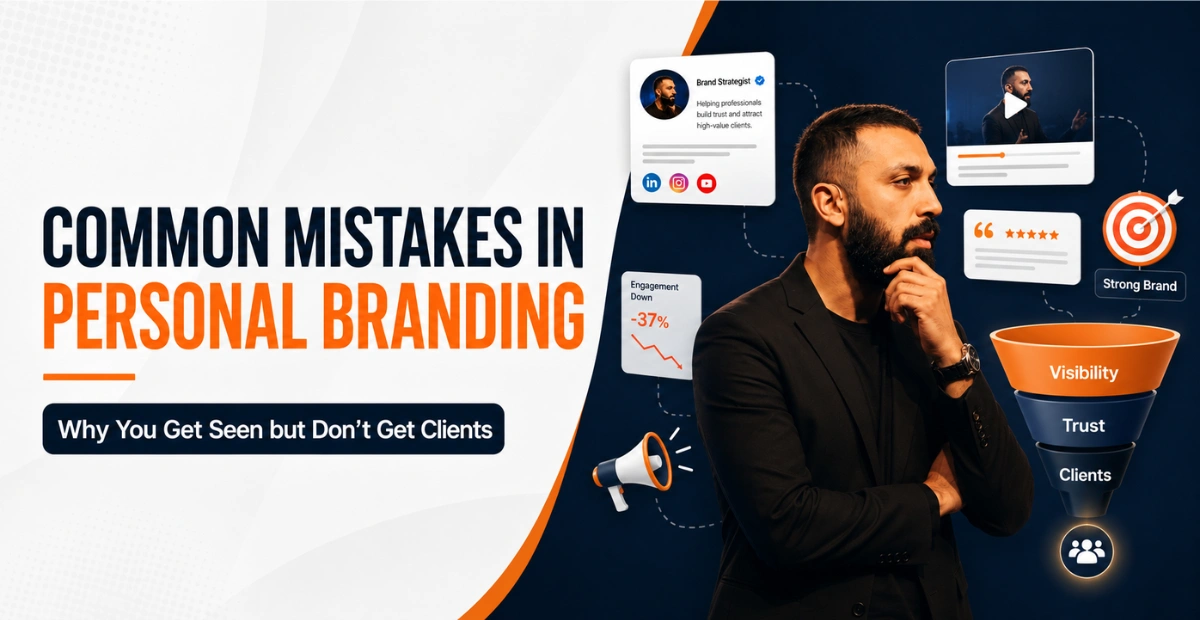
Building a personal brand is not just about posting content every day, showing up on camera, and waiting for people to magically trust your expertise.
Let’s be honest: many people are already doing that.
They create content, publish posts, record videos, share tips, and sometimes even get decent views. But at the end of the day, nothing serious happens.
No real clients.
No better opportunities.
No stronger professional position.
No meaningful business growth.
So what is the problem?
The problem is usually not that they are creating “too little content.” The real problem is that their personal brand has no system behind it.
Their audience does not clearly understand who they are, what problem they solve, why they should be trusted, and what the next step is after consuming their content.
In this article, we are not going to repeat the usual generic advice about personal branding. Instead, we will look at the common mistakes that make people visible online but fail to turn that visibility into trust, authority, and clients.
What Is Personal Branding?
Personal branding is the image people build in their minds about your expertise, personality, way of thinking, and value.
It is not just your logo, profile picture, color palette, or Instagram bio.
Your personal brand is created through your content, behavior, opinions, decisions, results, stories, and the experience people have with you over time.
In simple words:
Personal branding is what people associate your name with.
When someone hears your name, they should quickly understand what you are known for and why they should pay attention to you.
For example, if your audience is business owners, freelancers, creators, or consultants, they should be able to connect your name to a clear problem you help solve.
That problem could be sales, marketing, content strategy, positioning, business growth, digital transformation, or trust building.
If that connection does not exist, you may have online presence, but you do not have a strong personal brand yet.
Mistake 1: Trying to Appeal to Everyone
One of the biggest personal branding mistakes is trying to be interesting to everyone.
One day you talk about motivation.
The next day you talk about marketing.
Then productivity.
Then AI tools.
Then your personal life.
Then whatever is trending this week.
The result?
Your audience gets confused.
When people cannot understand what you are really known for, they may still like your posts, watch your videos, or follow your page. But when it is time to hire someone, buy a service, or ask for professional help, they usually choose the person with a clearer position.
A strong personal brand starts with focus.
You need to answer a few basic questions:
Who is your main audience?
What specific problem do they have?
How do you help them solve that problem?
Why should they trust your point of view?
You do not need to be for everyone.
In fact, strong brands are built by choosing a clear audience, not by trying to attract the entire internet.
Mistake 2: Creating Content Without a Clear Message
Content without a message is like a store with a nice window display but no clear product.
Many people publish content regularly, but there is no central idea behind it. After watching ten of their videos or reading ten of their posts, the audience still cannot explain what they really believe, what they stand for, or what problem they solve better than others.
A strong personal brand needs core messages.
For example, a business consultant might have a core message like this:
Businesses do not grow only by running more ads. They grow when their offer, positioning, sales process, trust-building content, and customer experience work together.
That message can then be repeated from different angles.
One post can explain why ads fail.
Another can talk about weak offers.
Another can analyze a bad sales funnel.
Another can show how trust affects buying decisions.
The topics may change, but the main message stays consistent.
That is how your audience starts remembering you.
Your content should not exist just to fill a content calendar. Every piece of content should add one more brick to the structure of your personal brand.
Mistake 3: Only Teaching Without Showing Personality
Educational content is useful, but it is not enough.
If all your content is made of tips, checklists, frameworks, and tutorials, people may see you as helpful. But that does not automatically make you memorable.
People do not connect only with information. They connect with perspective, tone, experience, stories, values, and personality.
This does not mean you need to overshare your private life. You do not have to turn every personal detail into content.
But your audience should be able to feel how you think.
They should know:
What you agree with
What you disagree with
What mistakes you have seen
What experiences shaped your opinions
What makes your approach different from everyone else’s
If your personal brand has no personality, you become just another educational account in a sea of educational accounts.
And let’s be real, the internet is already full of generic tips.
Your job is not just to share information. Your job is to make your thinking visible.
Mistake 4: Not Moving People From Awareness to Trust
Getting attention is not the same as building trust.
Someone may see your content ten times and know your name, but still not be ready to buy from you or work with you.
Why?
Because awareness alone is not enough.
Your content should move people through a journey.
First, they discover you.
Then, they understand what problem you solve.
Then, they start trusting your expertise.
Then, they see proof that you can help.
Then, they know how to take the next step.
If your content only gets views but does not build trust, your personal brand will stay weak commercially.
A personal brand should not only create visibility. It should create belief.
People need to believe that you understand their problem, that you have a serious point of view, and that you can help them get a better result.
Mistake 5: Having No Clear Offer
One of the most common reasons personal brands fail to turn into business is the lack of a clear offer.
Your audience may enjoy your content.
They may respect your knowledge.
They may even think you are professional.
But they still do not know what you actually sell.
Do you offer consulting?
Do you provide a service?
Do you have a course?
Do you analyze businesses?
Do you work with small businesses, creators, founders, or freelancers?
How can someone start working with you?
If these things are not clear, your audience has to guess.
And people do not usually guess their way into becoming clients. They move on.
A professional personal brand needs a clear next step.
That next step could be:
Booking a consultation call
Filling out a form
Downloading a free resource
Sending a message
Visiting your service page
Joining your newsletter
Watching a deeper training video
The exact format does not matter as much as the clarity.
If people like your content but do not know what to do next, you are leaving opportunities on the table.
Mistake 6: Chasing Virality Instead of Strategy
Going viral feels good.
Nobody hates getting more views. More reach can be useful. But if your entire personal branding strategy is based on chasing viral content, you will eventually lose direction.
Why?
Because the content that goes viral is not always the content that attracts the right clients.
A simple, funny, controversial, or emotional post may get a lot of attention, but that attention may come from people who have nothing to do with your actual target audience.
From the outside, the numbers look impressive.
But from the inside, the business result is weak.
For personal branding, audience quality matters more than raw views.
Instead of asking only, “Will this content go viral?” you should also ask:
Will this attract the right people?
Will this strengthen my positioning?
Will this build trust?
Will this help people understand my expertise?
Will this bring my audience closer to working with me?
If the answer is no, that content may be good for the algorithm, but not necessarily good for your brand.
Visibility is useful only when it serves your positioning.
Mistake 7: Talking Only About Yourself
Personal branding is about you, but it is built for your audience.
That may sound contradictory, but it is important.
If all your content is only about your achievements, your story, your opinions, your lifestyle, and your success, your audience may lose interest.
People care about themselves first.
They care about their problems, their goals, their business, their income, their confidence, their decisions, and their future.
So even when you share a personal story, connect it back to a useful lesson for your audience.
Instead of only saying:
“I went through this journey.”
Say:
“I went through this journey, and these are the three mistakes that slowed me down. If you are building your brand right now, avoid these.”
Now your personal story becomes valuable for the audience.
The goal is not to remove yourself from your brand. The goal is to make your experience useful, relatable, and relevant.
Mistake 8: Not Being Consistent
A personal brand is not built with one good post.
It is built through consistent repetition.
Many people create content seriously for one week, disappear for two weeks, come back motivated, then disappear again.
This makes it hard for the audience to remember them, trust them, or build a habit around their content.
Consistency does not mean you have to post heavy content every day.
It means your audience can expect you to show up regularly with a clear message, a clear topic, and a clear point of view.
If you cannot publish high-quality content every day, it is better to publish three strong pieces per week than to post weak content daily and burn out.
Personal branding is not a sprint.
It is a long-term process of building trust, memory, and authority.
Mistake 9: Creating Only One Type of Content
Not all content should do the same job.
Some content is meant to attract new people.
Some content is meant to educate.
Some content is meant to build trust.
Some content is meant to show proof.
Some content is meant to invite people to take action.
If you only publish educational content, people may learn from you but never buy from you.
If you only publish sales content, people may get tired.
If you only publish personal content, your professional positioning may become weak.
A strong personal brand needs a balanced content system.
A simple content structure could include:
- Attention content to reach the right people
- Educational content to show expertise
- Opinion-based content to show perspective
- Proof-based content to build trust
- Conversion content to invite people to work with you
When this mix exists, your personal brand does not just get seen. It actually works.
Mistake 10: Not Showing Proof and Credibility
Trust is not built only through claims.
If you say you are an expert, your audience needs to see signs of that expertise.
These signs can include:
Case studies
Client results
Before-and-after examples
Real business analysis
Behind-the-scenes work
Lessons from projects
Testimonials
Clear explanations of real problems
You do not always need huge numbers or dramatic success stories.
But you do need evidence.
For example, if you are a business or branding consultant, you can talk about real issues business owners face:
Why their Instagram content gets views but no sales
Why their ads do not convert
Why their website gets traffic but no orders
Why their offer sounds weak
Why customers do not trust them fast enough
Why their brand looks active but not professional
When your audience sees that you understand real problems deeply, they are more likely to trust you.
Expertise becomes powerful when people can see it in action.
How to Build a Better Personal Brand
If you want to build a personal brand that actually works, start with a few clear questions.
1. What Do You Want to Be Known For?
Your answer should not be too broad.
Words like “marketing,” “success,” “business,” or “self-development” are too general.
A better answer would be:
I help small business owners, consultants, and creators build a stronger brand, better content, and a clearer sales path so they can attract better clients.
That is much more specific.
People can understand who you help, what problem you solve, and why your content matters.
2. What Specific Pain Does Your Audience Have?
A strong personal brand starts from your audience’s pain, not only from your personal interests.
Your audience may struggle with things like:
Creating content but not getting clients
Running ads without getting sales
Not knowing how to stand out from competitors
Having a good service but poor communication
Getting attention but not building trust
Having followers but no business results
The better you understand your audience’s pain, the sharper your content becomes.
Sharp content gets remembered.
Generic content gets ignored.
3. What Is Your Unique Point of View?
Personal branding is not only about expertise. It is also about your perspective.
Two people can both be branding consultants, but one may look at branding through design, another through storytelling, another through sales, and another through business systems.
Your audience needs to understand your angle.
Why should they listen to you instead of every other expert in your field?
Your point of view is what makes your content feel original, even when the topic itself is common.
4. What Content Themes Should You Repeat?
Strong brands are built through repeated messages.
You should have a few content pillars that you return to regularly.
For example:
Personal branding mistakes
Business growth lessons
Marketing and sales strategy
Content strategy
Real business analysis
Client problems and solutions
Behind-the-scenes work
Consulting insights
Calls to action for working with you
These pillars help your content stay focused instead of random.
Random content may get temporary attention.
Focused content builds memory.
5. What Is the Path From Audience to Client?
If your goal is not just to become known, you need a conversion path.
After someone sees your content, what should they do?
Should they visit your website?
Read a deeper article?
Book a consultation?
Download a free guide?
Send you a message?
Join your email list?
Apply to work with you?
Without a clear path, your personal brand becomes like a shop with a beautiful sign but no visible entrance.
People may admire it, but they do not walk in.
Conclusion
Building a personal brand is not just about creating content.
If you produce content without clear positioning, a central message, a defined audience, a strong offer, and a conversion path, you may get attention but still fail to become the first choice in your audience’s mind.
A strong personal brand helps people understand who you are, what problem you solve, why they should trust you, and how they can work with you.
The biggest mistake is confusing online presence with personal branding.
Being visible is not enough.
You need to build a position in people’s minds.
If you are a business owner, consultant, freelancer, creator, or expert, your personal brand should not just generate likes and views. It should create trust, authority, and real opportunities.
So start with one simple question:
What problem do I want to be known for solving, and for whom?
Once you answer that clearly, your content, positioning, and personal brand will become much stronger.